
As told by Sasha
Sasha had always believed customer experience was about helping people. That's why most people get into CX in the first place — you want to solve the problem, want to make someone's bad day a little less bad, want to be the calm in the room when everything else is loud.
One shift changed how she saw the job.
Because sometimes the hardest part of CX isn't the angry customer in front of you. It's living with the consequences of a decision you were never part of making.
This is Sasha, in her own words.
Five minutes earlier, a man was screaming close enough that I could feel it on my face.
Another customer was gripping the counter like she was deciding whether to go over it. Somewhere behind me, my teammate had gone quiet in that specific way that means she's not okay, she's just out of things to say. I heard her say my name once, low — "Sasha" — just to check I was still standing.
Then it stopped. The last customer left. The floor went silent.
And a new one walked in.
I smiled.
"Good morning. Welcome. How can I help you today?"
Like nothing happened. Like five minutes ago wasn't real. Like my hands weren't still a little unsteady from adrenaline.
That's the job. Nobody tells you that's the job.
Here's what actually happened, and it wasn't a difficult-customer problem. It was a "nobody asked us" problem.
Somewhere above my pay grade, a manager made a promise. A deal, offered up to cool a room down and make a problem disappear for the day. I don't know exactly what was said. Neither did my team. Because we weren't in that conversation. We weren't consulted, warned, or even given a heads-up email.
A deal was offered to calm the situation down and keep customers satisfied in the moment. The problem: Sasha and her team were never involved. They weren't in the conversations. They weren't part of the decision. They weren't given the information they needed to prepare. But when the time came for customers to receive what they'd been promised, Sasha's team became the face of the company.
We inherited the promise. We inherited the anger.
Customers started showing up expecting what they'd been told. And when what they'd been told didn't match what we could actually do, we were the ones standing there to explain the gap. Not the manager who created it. Us.
You can watch someone's mood turn in real time. Patient becomes annoyed. Annoyed becomes loud. Loud becomes something else entirely once money is involved. I've had people get in my face. I've had people threaten to come around the counter. In those moments you're not thinking about NPS scores or "de-escalation frameworks." You're thinking about whether you're going to be okay in the next sixty seconds.
And underneath that, a quieter, uglier thought:
If something happens to me right now, would anyone even remember by next week?
That's not dramatics. That's just what it feels like to be the only visible person representing a decision you had no part in making.
The manager who made the promise wasn't standing next to us while it detonated. He didn't have to look anyone in the eye and say "that's not actually what's happening." He walked away from the decision. We became the face of it. He made the promise. We became the apology.
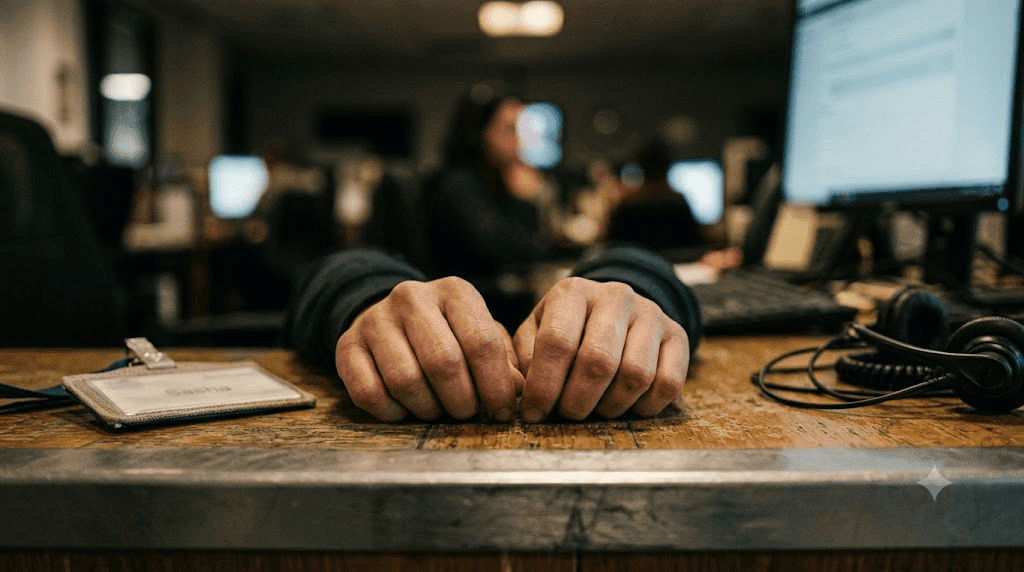
After it was over, there was no debrief. No "hey, are you two okay." No conversation about why a promise involving money went out to customers without the people who'd have to deliver it ever hearing about it.
What we got instead was a version of "let's talk about how that was handled."
Handled. As if there was a way to gracefully manage a promise we didn't know existed, made by someone who wasn't there to defend it, to a room full of people who had every right to be angry.
This is the part nobody puts in the training manual: toxic positivity isn't your manager telling you to "stay positive." It's a whole system quietly agreeing that your job is to absorb the consequences of other people's decisions and then act like it cost you nothing.
Because five minutes later, there's always another customer. And the job doesn't pause for what you just survived.
Smile.
Warm greeting.
"How can I help you today?"
As if fear has a five-minute half-life. As if the person delivering "the customer experience" isn't also, somehow, a person.
Sasha learned there's a difference between supporting customers and being used as a shield for decisions made without you. A great customer experience can't be built on broken promises and silent suffering. If leadership wants customers to trust the company, they have to build trust with the people delivering that experience, too.
What Needs to Change
- Nobody makes a promise to a customer without the frontline in the room. If it involves money, timelines, or exceptions, the people who have to deliver it need to hear it before the customer does — not from the customer.
- "How was it handled" isn't the first question after an incident. "Is my team okay" is. Then "what decision led to this."
- Leadership doesn't get to be invisible during the fallout and visible for the win. If you're willing to make the promise, be willing to stand there when it doesn't land.
- Employees need a real pause between an unsafe interaction and the next customer. Not a policy that exists on paper — an actual minute to not be smiling.
- Accountability has to point up, not just down. If the fix after a blowup is a coaching note for the frontline team and nothing for the person who made the promise, that's not a lesson learned. That's just where the blame was cheapest.
Final Thought
If leadership wants customers to trust the company, that trust has to start with the people who are actually standing in front of the customer.
You cannot build a great experience on a promise you never explained to the people delivering it.
So here's the question I'd put to anyone who's never had to walk that floor after it went sideways:
Would you have smiled?
If the answer isn't obviously yes — it's not a customer service problem. It's a leadership one.
— Sasha